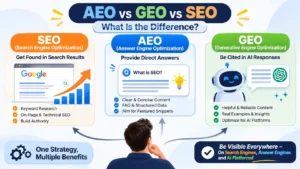
In addition to traditional search engines, more people are turning to platforms built on artificial intelligence to answer questions, compare services and discover new companies.This has made AEO (Artificial Intelligence Engine Optimization) vs GEO (Geographic Search Optimization) vs SEO (Search Engine Optimization) a major issue for companies wanting to increase their online presence.
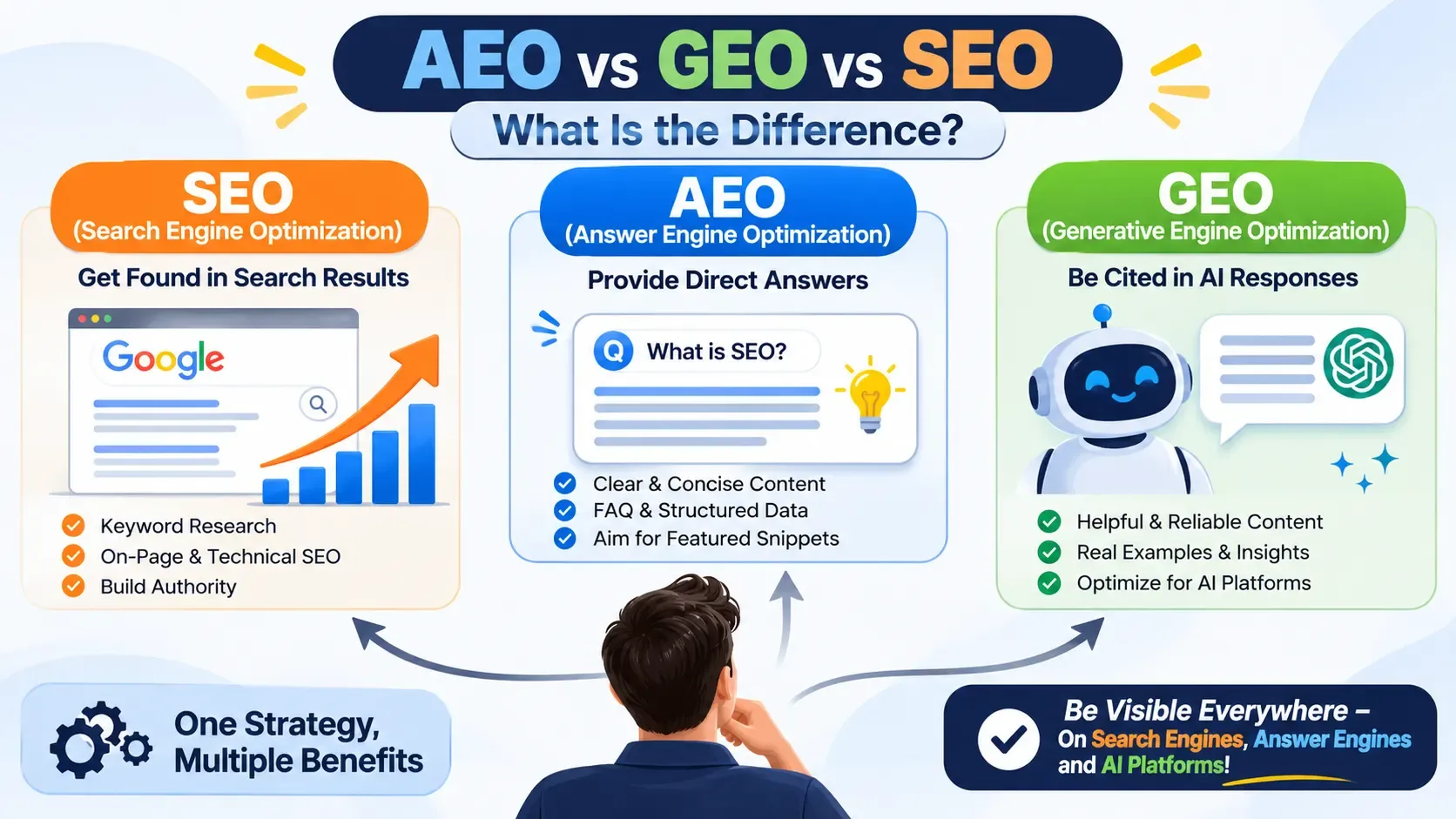
The goal is the same whether it’s traditional SEO, Answer Engine Optimization (AEO) or Generative Engine Optimization (GEO): to help people find relevant data. But each method addresses a different part of the total search process.SEO is used to improve the ranking of a website in search result listings, AEO is used to enable content to appear as direct answers and GEO is used to increase the visibility of content in responses generated by artificial intelligence.
Grasping these differences will enable businesses to develop a better search strategy.
What Is Traditional SEO?
SEO, or Search Engine Optimization, is the ongoing process of enhancing a website so that search engines can locate, comprehend and rank the pages of your site in accordance with their relevance to a searcher’s query.SEO’s end goal is to bring in the right organic visitors through quality content and technical accessibility.
Traditional search engine optimization (SEO) includes keyword research, on-page optimization, technical SEO, internal linking, website speed/performance, and establishing credibility for your site.
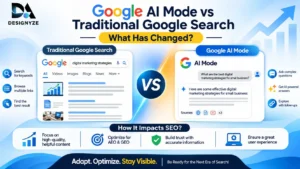
Also, a searcher who is looking for a “digital marketing company in Delhi”, can use google to research and find the companies that provide this service. After that, they can see the different types of services they provide. If a company’s website is optimized correctly, it will have a higher chance of being found when people perform relevant searches and thus attract potential clients.
The basics of Search Engine Optimization (SEO) are still a very basic part of how people find you on the Internet, but as the ways people search on the Internet change, so does what is considered “basic” SEO.
What Is Answer Engine Optimization (AEO)?
Answer Engine Optimization (AEO) is a process of organizing website content in an easy to comprehend manner, and in a way that allows answer-based platforms to understand the information provided on your site and then use that information to provide an answer to a user’s question.
SEO (Search Engine Optimization) usually concentrates on getting your site listed higher in search results. AEO (Answer Engine Optimization), on the other hand, is more concerned with delivering answers to users’ questions.
A user can type in a search query such as “What is the difference between SEO and PPC?”A page that answers this question in clear terms, with descriptive headings and answers the question in a concise way is likely to be better understood by search engines.
Some of the most successful AEO tactics include providing well-written explanations, creating appropriate titles for organizing content, answering frequently asked questions, and updating content.Use these tactics to increase the likelihood of your content appearing in featured snippets and other kinds of search results that provide answers to users’ queries.
What Is Generative Engine Optimization (GEO)?
GEO, or Generative Engine Optimization, is about making sure that the content that you create for your website and/or brand can be found and used by the different types of artificial intelligence (AI) systems.
The use of tools such as ChatGPT, Gemini and Perplexity allows for the generation of responses that are formed through the combination of various sources. GEO seeks to create a website’s content that is sufficiently reliable and relevant to be incorporated into the AI-generated responses.
AI can be asked by a user for examples of digital marketing services that would be applicable to a small business. If the AI is provided with clear service descriptions, useful advice, original perspectives, and consistent information about the company’s offerings, then it will have a better understanding of what the company provides.
GEO is not making any promises about how long it takes for a business to be mentioned by an AI platform. GEO’s goal is to improve the quality of information provided to the user, the way that information is presented and the ease at which the user can access that information.
AEO vs GEO vs SEO: What Are the Main Differences?
The fundamental difference among SEO, AEO, and GEO is the specific type of exposure each methodology intends to enhance.
SEO is about getting your web pages to rank in the relevant search engine results and driving organic traffic. AEO is all about making information easy to digest in response to a user’s question.GEO wants to create content that is relevant and accessible to AI-generated responses, so they can cite websites or brands.
The two approaches described here are related, not entirely independent. A well-constructed web page can provide support for traditional search engine results, answer-focused search experiences, and search results generated by AI.
Can SEO, AEO and GEO Work Together?
Indeed. Businesses can use one content strategy to satisfy the demands of SEO, AEO, and GEO.
Consider a blog explaining how Google Ads works. SEO will allow the blog post to appear when someone searches for Google Ads. AEO will provide easy access to answers regarding questions like what is the recommended amount of money for beginners to use on Google Ads. GEO will enhance the blog post by incorporating real-world examples, accurate descriptions and relevant data that AI is able to understand.
Google has also stated that their current search engine optimization (SEO) techniques are still applicable to the artificial intelligence (AI) features used in their search results. Therefore, there are no additional technical requirements for webmasters to follow to ensure their site appears in AI-created search result pages.
How Do You Measure SEO, AEO and GEO Performance?
The measurement of SEO performance is accomplished via organic clicks, search impressions, keyword visibility, site traffic, and conversion rates. Businesses can determine their sites’ performance using Google Search Console and Google Analytics 4.
AEO results can include tracking featured snippets, the location of the answers, search impressions and the referral traffic if possible. There is not one single form of tracking for all answer platforms.
GEO measurements can include tracking of brand mentions, cited web pages, and referral traffic to your site from artificial intelligence (AI) platforms. Bing Webmaster Tools provides an AI Performance Report which shows how often you are cited as well as what types of questions people ask you through AI platforms.
An AI citation does not necessarily indicate that someone visited your website, inquired about your services/products, or made a purchase from you.
Which Is More Important: SEO, AEO or GEO?
Every business has unique needs. Search engine optimization provides a solid base for finding your site on-line; answer engine optimization helps you provide direct answers to people’s questions; and search engine optimization in the context of generative artificial intelligence (GEO) allows you to be visible within those types of environments.
An e-commerce business would likely concentrate on search terms that relate to products, and provide clear product descriptions. On the other hand, a professional services firm would probably be best served by having helpful blog posts, descriptive service pages, and providing answers to frequently asked customer questions.
The appropriate method will depend upon the business itself, who the audience is, and what they do when searching for information about potential purchases.
Conclusion
The understanding of AEO, GEO and SEO allows businesses to adapt their online search behavior to meet changing trends. While SEO supports the traditional search visibility of a business, AEO allows for easier use of content in providing direct answers to users’ queries, and GEO assists with the discovery of products or services via AI-generated responses.
Instead of relying solely on one method, companies can create a unified plan using relevant content, understandable data, accessible technology, and reliability. This will provide users with easily findable and relevant information as they search.