Search engine optimization (SEO) is still important since both search engines and artificial intelligence (AI) systems use information that can be found on the internet. For example, if you do a traditional search using Google or if you ask an AI system a specific question about something, the AI will need to find reliable information to be able to help you answer your question.
Google continues to put a lot of money into artificial intelligence-based search, but also keeps the relationship between what is created by AI as responses and the web sites. Google says it has more than 2.5 billion users a month using AI Overviews and more than 1 billion a month using AI Mode.
This fast pace of development for AI search shows that traditional website search is not obsolete.And businesses can use both traditional search engine optimization (SEO) and artificial intelligence-based search optimization (AI search optimization) as two components of an overall digital marketing strategy.
The Impact of AI Search on Traditional SEO
In the past, SEO was used to increase the position of a website in the search results for specific keywords. Companies have historically optimized many aspects of their websites such as titles, headers, content, internal links, back links, and technical areas of the site to increase how visible they appear organically on search engines.
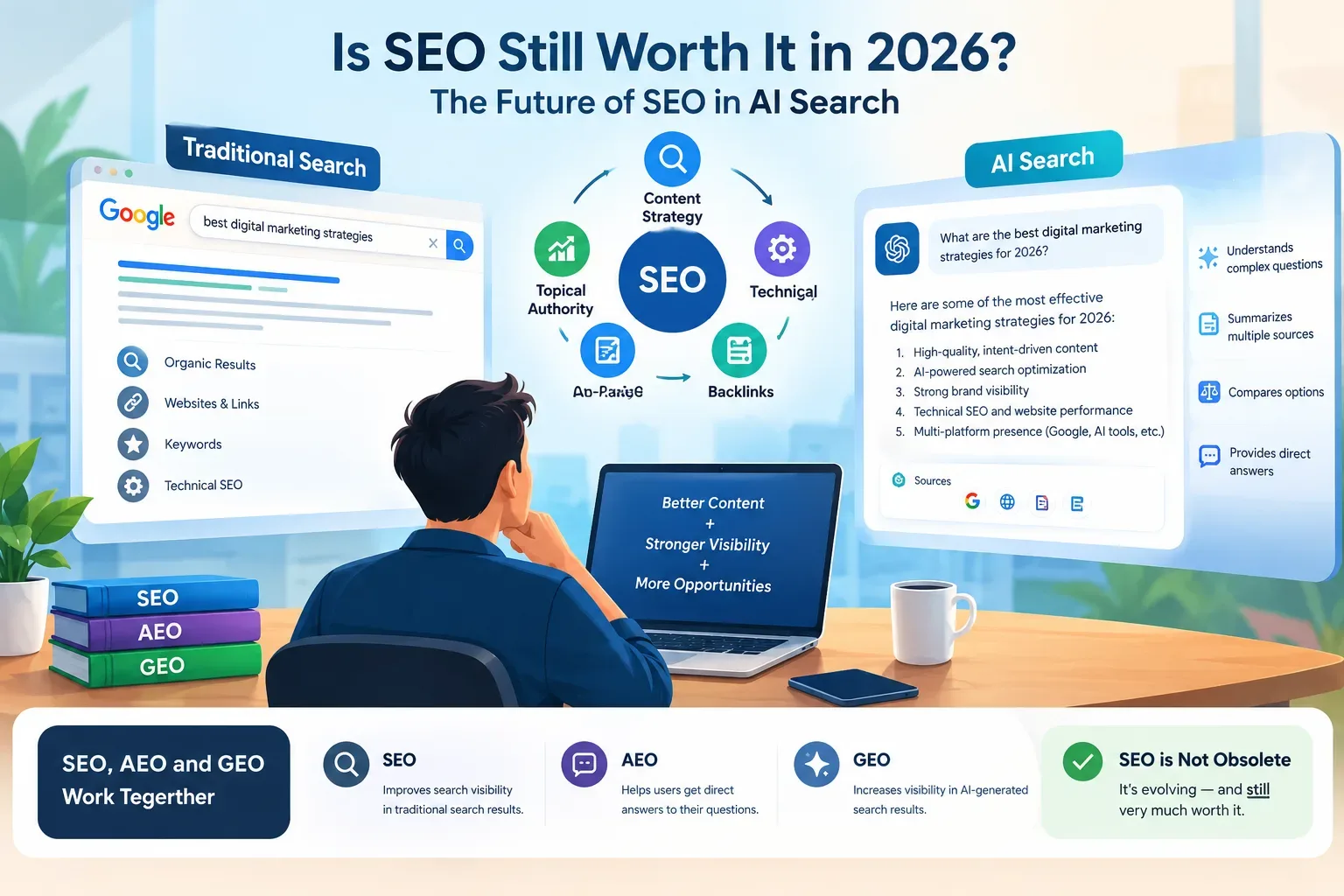
AI-based search has a different feel to it. Rather than just giving you a list of websites, an AI search tool is capable of understanding complex questions, summarizing information from multiple sources, comparing options, and answering questions as if you were speaking with someone.
As a result, search visibility is becoming broader.
The search engine Google can show a webpage in its organic search results, use that page as a source for an AI-generated Overview, cite that page in an AI-generated response, or influence a person to visit that page.
The open web continues to play a major role in the way AI-based searching takes place. Google is continuing to provide access to relevant web pages and links via both AI Overviews and AI Mode.
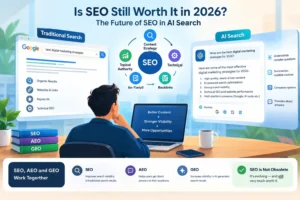
This allows businesses to create more of an integrated relationship with traditional SEO, AI SEO, Answer Engine Optimization (AEO), and Generative Engine Optimization (GEO).
Does Traditional SEO Still Matter for AI Search?
Technical SEO allows search engines to read and comprehend a website. Internal links link pages to each other . Clear headers and organization of content makes things easier to understand. Keywords related to the subject matter of the site assist with establishing relevance to the topic, and credible content enhances the authority of a website.
Recent reports have shown that Google’s AI-based search system still relies upon traditional search engine ranking and retrieval techniques prior to producing an answer using generative AI.
Therefore, the basic tenets of conventional SEO will continue to be a vital building block for optimizing your site for use with artificial intelligence search engines. Businesses should not stop practicing SEO just because their customers are increasingly utilizing AI platforms.
SEO, AEO and GEO: What Is the Difference?
SEO improves search visibility in traditional organic search results. AEO improves how easy it is to find information using systems that provide direct answers. GEO improves how visible your website can be in the search results generated by AI.
A modern SEO strategy can incorporate elements of all three.
An example of this is a company optimizing their website technically, writing content based on real search queries, answering questions posed by customers directly, showing their expertise in the field, building credibility in the industry, and formatting their content so that it is easily understood by users and search engines.
The goal isn’t to pick either traditional SEO or AI SEO; the goal is to make content that will work well in both types of search environment.
Will AI Replace SEO?
AI is changing search, but it is not making SEO obsolete.
People will turn to search engines and websites to find companies, services, products, reviews, research and in-depth information. Artificial Intelligence (AI) can potentially impact how people locate these resources; however, websites are still essential for finding out what’s going on with both learning about the world and doing business.
Google states that overall organic clicks on Search for website visits have been similar from one year to the next; however, the value (or quality) of those clicks has increased.
The statement “AI has destroyed SEO” is an oversimplification. It is highly likely that both SEO and AI search will develop simultaneously.
The Future of SEO Is Broader, Not Smaller
So, is SEO still worth it in 2026? Absolutely.
The biggest change has been how companies measure their SEO success. SEO is no longer just about getting a page on your site to rank well for a particular phrase in search engine results.Today it’s all about giving consumers the most relevant, reliable, credible and trustworthy information possible across all search platforms.
SEO’s future includes the combination of traditional SEO, technical SEO, content strategy, topical authority, AI search optimization, AEO, GEO and brand visibility. For businesses adapting to these changes, Designyze provides SEO and digital marketing solutions focused on building stronger online visibility.
Businesses with a focus on understanding what users are looking for when they conduct searches (search intent), creating high-quality content, ensuring their website can be accessed by both humans and machines (technical accessibility), and delivering real value to the customer are more likely to have success in being discovered through Google Search as well as via AI-based discovery platforms. There is no longer a choice to make regarding whether to pursue search optimization through Google or AI-driven discovery platforms; the challenge now lies in establishing a digital presence which can be located, comprehended, trusted, and utilized as a resource for the user no matter where they search.