Publishing a website doesn’t mean that it will show up on Google. Although you may write helpful articles, and use SEO techniques to optimize each page of your site, getting people to find your site through an organic search takes patience. If you’re asking “why is my website not showing up in search results?” there are several possible reasons for this problem. These include: indexing problems with Google, technical problems with your site, poor quality content (or content that isn’t relevant to what searchers are looking for), and strong competition from other sites.
The most important thing to do when attempting to improve search engine results is to identify what the actual issue is. Rather than making arbitrary modifications to your site, take a close look at it and determine areas where you can make changes that will benefit both search engines and your audience.
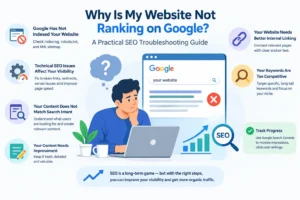
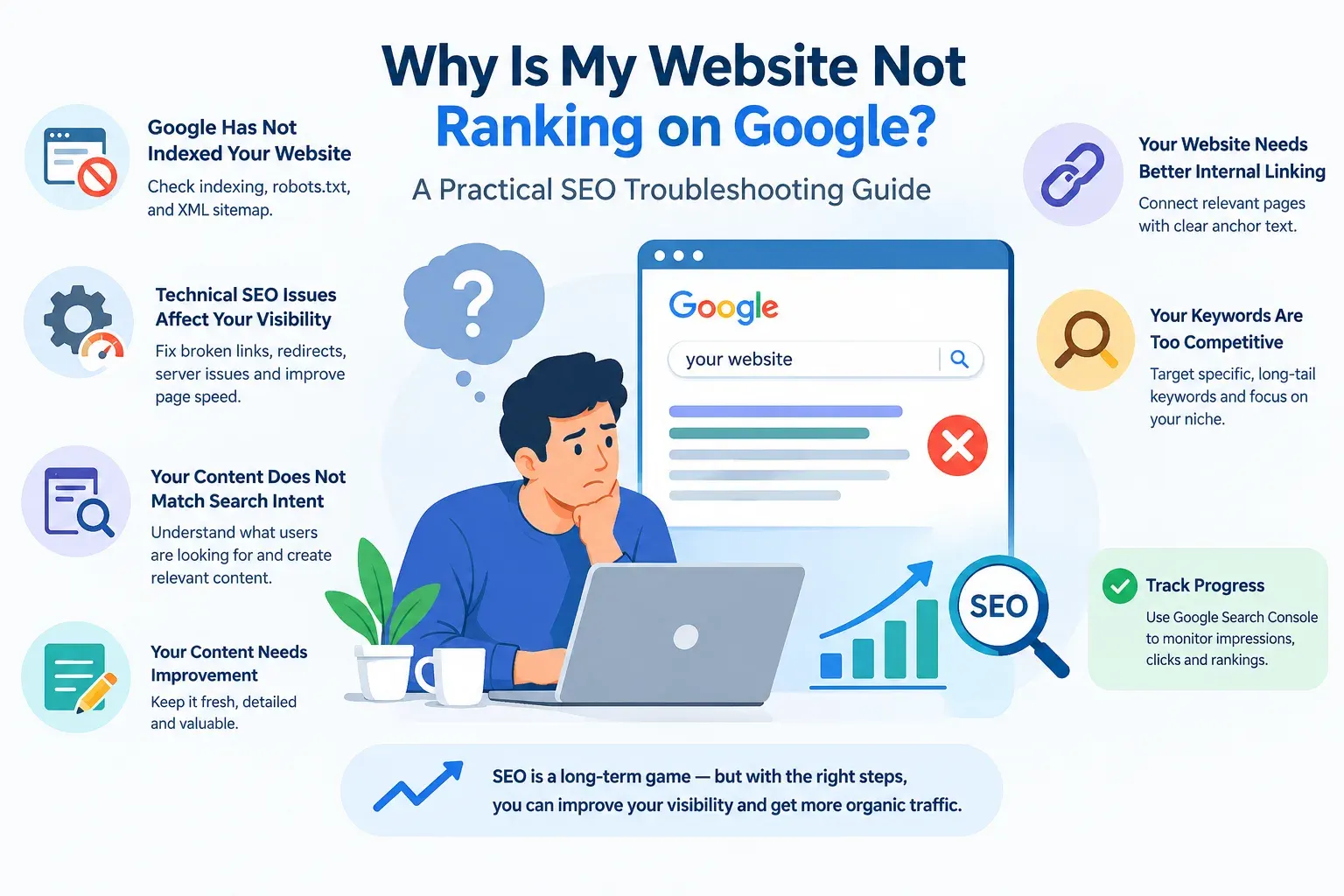
Google Has Not Indexed Your Website
A page usually must have been indexed prior to appearing in organic search results from Google. Therefore, if you are a relatively new website, or if you have some very important pages that are currently un-indexed, then checking for indexing should be among your top priorities.
Google will not crawl your site if you have a noindex tag, a crawl block on your site, or if the page is buried in internal links. Also, duplicate URLs and server errors can prevent Google from crawling your site.
You should use the URL Inspection tool provided by Google Search Console to examine specific pages. You need to review your robots.txt file and indexing settings to make sure that search engines can view essential parts of your website. Additionally, you may want to submit an XML sitemap to assist Google in finding new URLs, but submitting a sitemap doesn’t guarantee that those URLs will be indexed.
Technical SEO Issues Affect Your Visibility
Technical SEO provides search engines a way to find and interpret the content on your site. If there are any problems with the way users access the site, such as broken links, bad redirects, server issues, or slow page loading times; then these issues will negatively affect the overall performance of the site and how the user experiences it.
Perform a technical SEO audit to locate problems with crucial pages. Examine mobile usability, assess how quickly pages load, and repair damaged internal links. You may find Google Search Console useful for identifying crawl and indexing problems.
You should prioritize solving problems which restrict both people and search engines from viewing key parts of your site. This will help you create a better base on which to build your SEO efforts.
Your Content Does Not Match Search Intent
If your pages don’t provide the answers people are looking for, you’ll find it difficult to rank in search results. When someone is searching for a step-by-step guide, they expect to see detailed instructions on how to complete a task, not just a broad overview of the topic.
Search your target keyword on Google. Examine the kinds of pages that appear in the search results. Think about what users are looking for – a guide, comparison, service page, or product recommendation.
By answering the primary question directly, utilizing appropriate headings and providing examples that will assist the reader, you can improve your content. SEO-optimized content which is effective, is geared towards assisting the reader, not merely repeating keywords to excess.
Your Content Needs Improvement
With the current environment of digital marketing, content that is either too thin, out-of-date, or repetitive may not be able to successfully compete against content that provides users with a greater amount of relevant information. Additionally, simply publishing more articles will not guarantee improved rankings, as long as your existing pages do not provide value to the reader.
Your content needs to be reviewed to ensure there is no missing information, that it does not contain outdated information, and that all explanations are clear. Additionally, provide real-world examples and unique perspectives which will provide value to your readers.
The most important thing to do with an article is to keep it current. If the information has changed since you wrote the article then update it. Also, take out anything in the article that isn’t directly related to the subject of the article. Instead of trying to add more words to make the article longer, focus on making sure that your readers are getting what they want out of reading the article.
Your Website Needs Better Internal Linking
Internal links are used to link related pages and to allow users to easily find information on a website. They also assist search engines in discovering content, and understanding the relationship among the various pages.
Review your website’s organization and connect relevant articles to relevant service pages, guides, and categories. When linking articles to other parts of your website, utilize descriptive anchor text that provides a clear explanation of where the user will be directed to. Additionally, make sure all relevant information is accessible to users.
Your Keywords Are Too Competitive
If you find yourself competing with big brands that are already ranking for the same keywords as your optimized content, then even the most optimized content can be hard to rank. This is especially true if you are trying to use broad terms (keywords) as your main target, since there is usually a lot of competition for these terms in many different areas.
Use specific search terms that reflect what people are searching for. For example, a small business can use more targeted service-related searches than broad search terms.
Select relevant keywords that relate to what you know best, write informative articles about those topics, and do not try to make words fit in the right place. To develop good search engine visibility you will need to put forth an ongoing effort and clearly understand who you are writing for.
Conclusion
If you’re having trouble getting your site ranked with Google, take a look at how it’s indexed, and check for any technical SEO problems. Next, consider what people are looking for (search intent), the quality of your content, the internal links you use on your site, and the amount of competition for keywords you’re trying to rank for. You can use Google Search Console to track impressions, clicks and average ranking positions to see if you are moving forward.
SEO is a long term game, there is no magic wand to pump your ranking overnight.However, by using data to find areas for improvement and making the right changes, you can boost your site’s visibility on search engines and produce regular organic traffic.