The competition among those involved in commercial real estate is high. Those who are looking to sell or invest in commercial real estate will be doing more than just displaying a list of properties. Those involved in buying/investing in commercial real estate will have researched the location, compared the available commercial space and evaluated the opportunity for investing prior to making a decision. As such, it is important for those developing commercial real estate to have an online presence that allows them to display their projects to the appropriate audience.
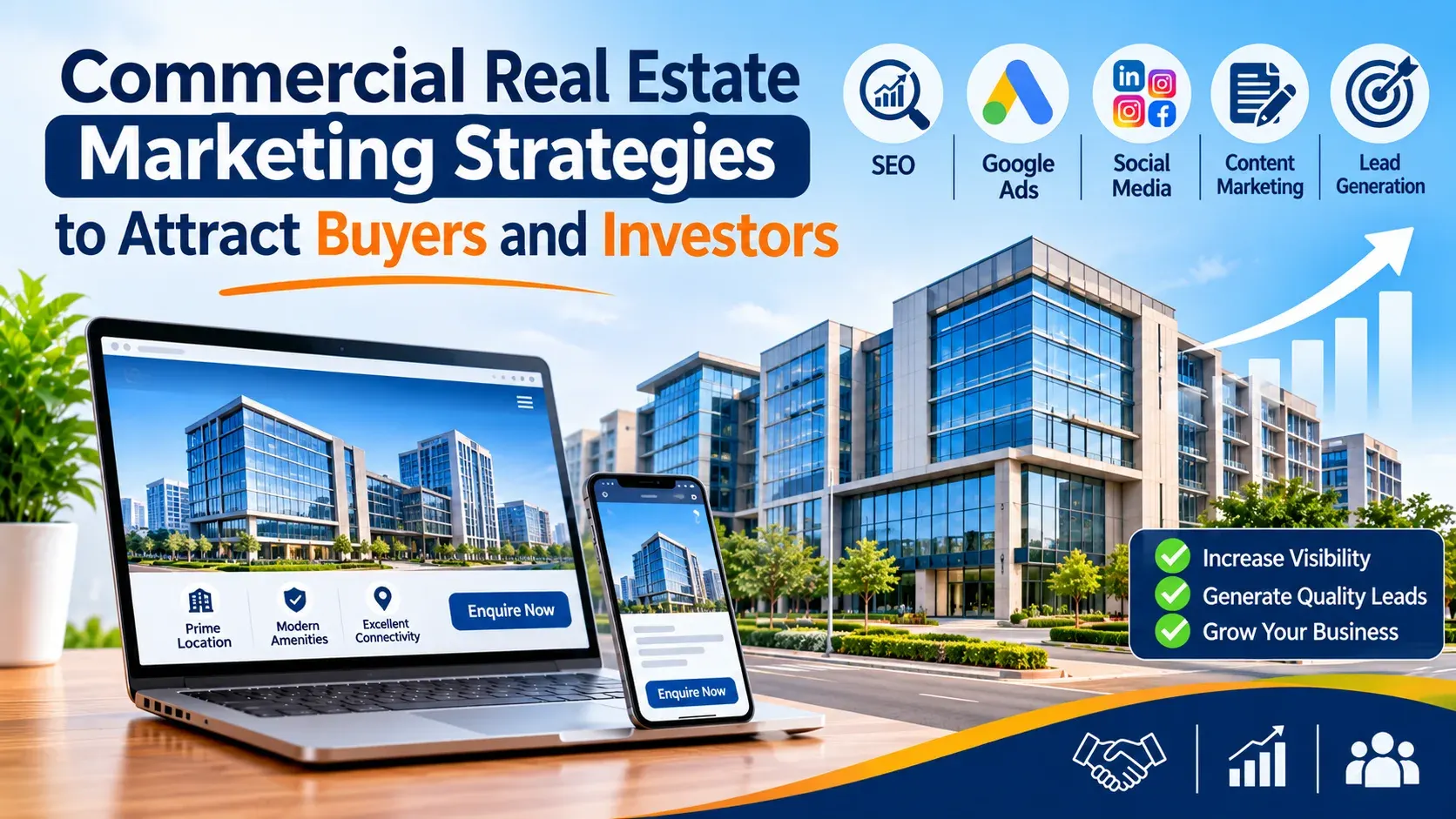
Successful commercial real estate marketing strategies utilize search engine optimization, paid advertising, social media, website design, and informational content. Each of these strategies enables commercial property developers to increase their online presence, communicate the value of projects, and produce relevant inquiries.
Why Is Digital Marketing Important for Commercial Real Estate?
In today’s world of technology, people are searching online for real estate opportunities long before they ever contact a developer. Buyers and investors are looking at office space, retail stores, commercial properties, and industrial parks on-line to determine if these locations will meet their needs. They are trying to find out where the property is located, how accessible it is, what amenities are nearby, how much space is available, and whether or not the property would be suitable for what they plan to do with it.
Developers can utilize digital marketing to share information about their products and services with target demographics through applicable online channels. Additionally, digital marketing can aid developers in reaching those individuals who are actively looking for commercial real estate within defined geographic areas. Finally, developers may develop a strategic digital plan that will assist them in developing brand recognition, establishing themselves as credible sources of information and producing consistent leads.
Search Engine Optimisation for Commercial Real Estate
SEO (Search Engine Optimization) is used by businesses that sell commercial properties to assist with their visibility on the web. By optimizing your website for the keywords “commercial property”, “office space for sale”, “retail space” and “commercial property investment”, you will increase the chances of potential customers finding you when they are searching for these types of properties.
Create separate web pages for each project, each type of property and each area where you develop. These web pages need to include correct project details, appropriate search words, clear headings, and helpful details about the properties.
Because many times when making real estate purchases, people consider the location of a site before deciding if that site would meet their requirements; local SEO can be an effective way to help potential buyers determine if the site being advertised will work for them.
Google Ads for Commercial Property Lead Generation
Google Ads provides commercial real estate developers the ability to advertise their properties to individuals who are currently looking for commercial space or investment opportunities. Campaigns can be created around relevant search queries, targeted geographic areas, and particular types of properties.
A campaign-specific landing page can help maximize the effectiveness of your campaign by clearly displaying information about the project, including photos of properties, where they are located, and how users can get in touch with you. It is also important for developers to track how many quality inquiries they receive, what percentage of those inquiries convert into customers, and how much money they spend on advertising, to see if their campaigns are reaching people who would be interested in buying from them.
Social Media Marketing to Promote Commercial Projects
The use of social media in marketing can help a developer create brand recognition for their projects while presenting those commercial projects to possible buyers, investors, and/or business owners. The different social media platforms (i.e. LinkedIn, Instagram, Facebook) provide multiple methods of communication for a project and ways to connect with potential target markets.
Developers have several options for sharing property walkthroughs, construction progress, location highlights, available space, and other developments in a project. In addition to using written descriptions to inform prospective clients about projects, they may use professional photographs and informative videos to illustrate what the development is like.
Communication is what helps to keep the project in front of potential buyers as they consider other commercial real estate opportunities.
Build a Website That Converts Visitors into Enquiries
A commercial real estate website must do more than display appealing images of properties. Users of the site will require accurate and consistent information about each property in order to determine if they want to contact you for further details.
The most essential content of a website includes specifications for properties, floor plans, amenities available at each property, location map of the area surrounding the properties, information on how to reach the property (connectivity), if the property is currently available and what are the ways to contact the owner/agent. To enhance the user’s browsing experience, you may use high-quality images/video, provide virtual tours of the properties, and make sure that there are clear ways to submit inquiries regarding the properties.
A mobile friendly website is also very important, since most potential buyers and investors will use their smart phones to research commercial property listings. Navigation on your site should be simple and easy to understand. Your project pages should be organized in a way that makes it easy for visitors to find the information they need.
Content Marketing to Educate Buyers and Investors
Content marketing provides an avenue for commercial property developers to provide answers to questions frequently asked by potential buyers and investors as part of their search for properties. By developing and publishing content such as articles on commercial property investments, selecting a site for an office location, what is required when selecting a retail space, and things to consider when entering into a commercial lease agreement, content marketing can help attract those who are interested in the topics being covered.
Developers should publish more than just ads about their properties. Developers can use their websites to provide information about the process of buying/selling a home or other types of real estate. Providing this type of helpful information will help establish trust with potential customers, increase visibility on search engines (organic), and ultimately assist readers in understanding what they need to consider prior to purchasing/selling a property.
AEO and GEO for Commercial Real Estate Visibility
Search engine and AI platform users are continuing to search for answers to their questions. AEO and GEO are two ways businesses can organize the content on their websites to make it easier for search systems to find the most relevant information.
Commercial real estate web sites can answer specific questions, organize the content with clear headings and provide accurate information about projects, locations, and property features. Providing detailed answers to questions regarding commercial property investments, selecting office space, and choosing retail locations can enhance the usefulness of the content for both readers and AI driven search experience.
Consistent business data and relevant, believable content also strengthen an organization’s internet profile.
Measure Digital Marketing Performance
To be effective, developers must continually monitor their marketing efforts in order to identify those methods that produce the best outcomes. Developers need to assess the effectiveness of their organic traffic, search engine visibility, paid advertising, lead source, and lead quality.
By tracking the metrics, you will be able to see which of your marketing channels bring in prospects who match your target audience, as well as where you need to make changes. Also, by regularly reviewing these metrics, you can modify your marketing strategy as buyers’ habits and requirements in the marketplace evolve.
Conclusion
Commercial real estate requires a blend of visibility, informative content, and continuous communication to attract both buyers and investors. A more effective digital presence can be achieved through SEO, Google Ads, social media marketing, website optimization, and content marketing.
As a result of using strong marketing techniques, such as those that are used when advertising in the area of commercial real estate, developers will be able to show off their developments in a much clearer way, find relevant groups of people to target and generate increased interest in people calling up to make an inquiry about a particular property. An organized approach to SEO (Search Engine Optimization), AEO (Answer Engine Optimization) and GEO (Geographic Engine Optimization) can help ensure that commercial properties continue to be easily found online by consumers who are looking for information about them.