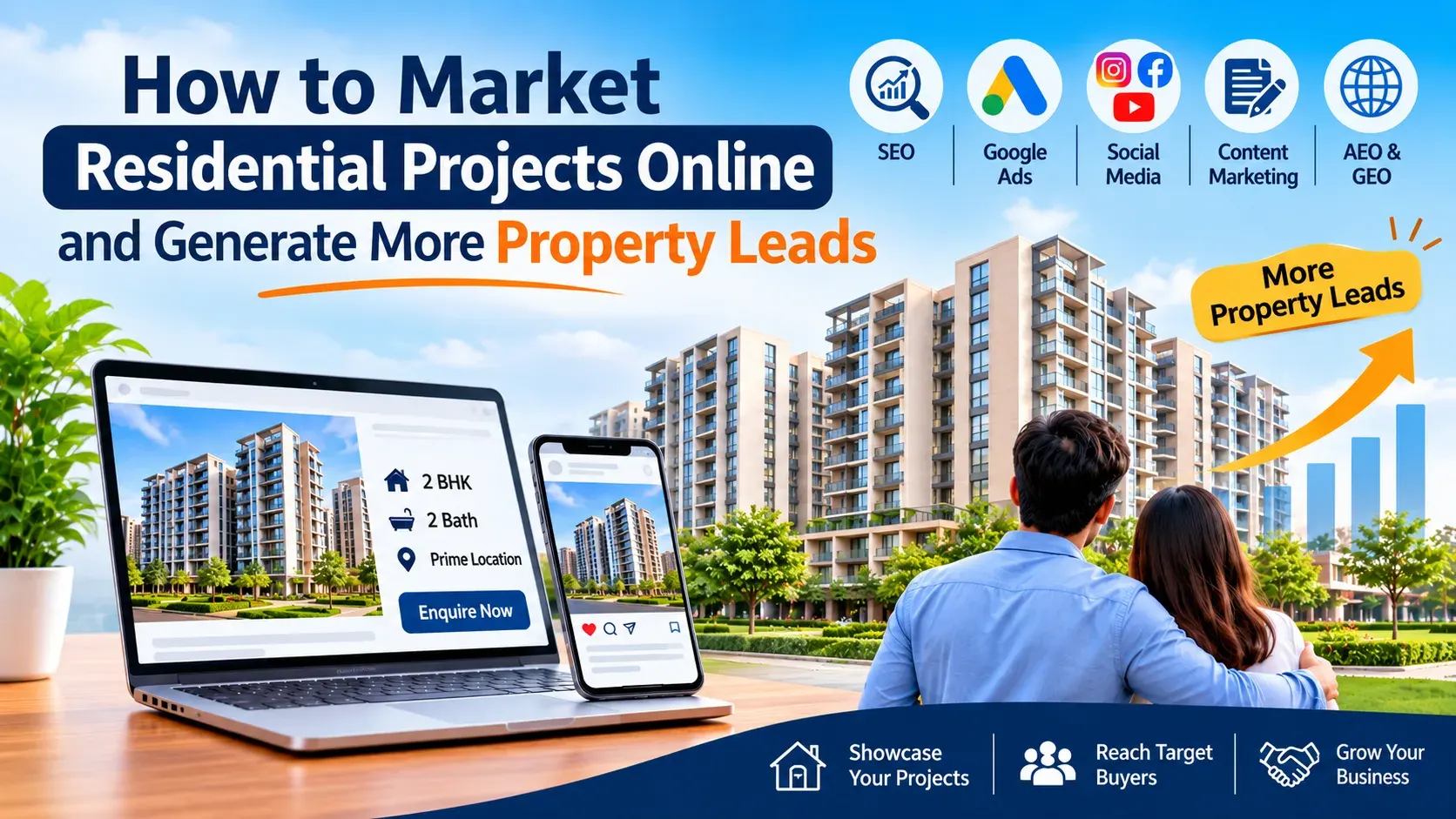
In recent years, the process of finding and purchasing a home has undergone a major shift. Currently, many prospective buyers start looking for properties via the Internet prior to contacting developers, visiting potential home sites, or consulting with real estate professionals. Buyers will use the Internet to review location options; examine various apartment layouts; assess the availability of amenities at each site; analyze pricing trends in the area; and evaluate the reputation of each developer.
The transition has provided a means for digital marketing to become a key element of the residential project marketing strategy. Developers may utilize various forms of digital media to display their products, provide helpful resources, establish trust with potential customers, and target individuals who are currently seeking to purchase a home.
A properly planned out digital marketing strategy enables residential real estate developers to have a better understanding of how people buy homes, increase their online exposure, and draw in additional applicable home buying questions.
Why Is Digital Marketing Important for Residential Projects?
Most buyers will spend time looking at different types of housing in order to find something that fits within their budget, has the right location for them, and meets their needs as far as how they want to live.
Digital Marketing can help a developer remain visible to a consumer as he/she is making a decision regarding buying a home. SEO, Social Media, Google AdWords, and informative content on a website can all be used by developers to advertise to potential consumers who are looking for homes in various stages of their home-buying process.
For instance, one person looking to buy a 2 BHK apartment in Noida could find a development via Google, and another person who is also interested in buying a 2 BHK apartment in Noida could view that same development via an Instagram video or a property walk-through.
Consistent internet presence will enable developers to communicate with other audiences outside of the traditional advertising channels.
How SEO Helps Residential Projects Reach Potential Buyers
Residential project websites can utilize Search Engine Optimization (SEO) to increase visibility in relevant Google search results. Home buyers typically use search terms such as; location of the home, number of bedrooms/bathrooms in the home, price range of the home, amenities/features that are available with the home.
Searches such as “residential projects in gurgaon,” “luxury apartments in delhi ncr,” “affordable flats in noida,” and “new residential projects near me” are examples of the various types of property required.
Developers are able to reach out to people who conduct those searches via optimized project pages, location based landing pages, informative blog posts and detailed property descriptions.
Local SEO is equally as crucial for residential development. Providing accurate details on surrounding amenities such as schools, hospitals, metro systems, malls and road networks will provide potential home buyers with an understanding of where the development is located.
The goal of residential development SEO is to draw in visitors that may be interested in the available real estate.
The Role of Google Ads in Residential Property Marketing
SEO will help residential developers create a lasting presence online and get found organically over time. Google Ads can help developers find new potential customers by creating targeted paid search marketing strategies.
Developers will be able to target their advertising to users who are searching for apartments for rent, new housing developments, residential areas and particular types of apartments.
A developer starting a new development in Greater Noida has the option to focus on potential customers who are looking for apartments within the Greater Noida region.
However, being able to successfully use Google Ads is more than just spending money on ads. There are other things that will impact your results such as: — How well you choose keywords — Who you target with your ads — Where you want to show your ads — What you say in your ads — The quality of your landing pages
The user will find a landing page which clearly provides information on how the apartment is laid out (configurations), what type of amenities are offered within the development (project amenities), where the property is located (location details), the cost of purchasing the property (pricing) if that information has been provided, and ways for users to contact the company for further inquiry (enquiry options).
How Social Media Marketing Builds Awareness for Residential Projects
Developers can use social media platforms like Instagram, Facebook and YouTube to showcase their residential projects to prospective buyers.
Visual information can be found in a number of areas including project updates, construction progress, apartment walkthroughs, sample flat videos, amenities and location benefits.
A video that shows the interior of an apartment, the club house, the landscaped area and the proximity to other amenities can provide buyers with some insight into what the development offers prior to having to schedule a site visit.
Posts related to purchasing a home, documenting a property, and comparing different neighborhoods or areas will help create opportunities for consumers to interact with your business in a positive way.
Why Website Experience Matters for Residential Projects
When someone visits a residential project’s website they will typically get their first in-depth look at what the project has to offer. They must have easy access to all relevant property details on that site.
A professional website needs to have information about how many apartments are available for sale, what the layout of each unit looks like (floor plan), what type of amenities will be provided, where the property is located, update on when the project will be finished, company background for the developer of the project, and contact information.
In addition to having a site that looks great on desktop computers, mobile responsiveness is just as critical since so many home buyers are researching homes through their phones.
The overall experience for users of a site that loads quickly, has easy to navigate pages, is written clearly, uses quality images, and provides accessible contact forms will be significantly improved. Virtual tours and accurate floor plans may provide additional clarity to potential purchasers of the home.
How Content Marketing Supports Homebuyer Decisions
First-time homebuyers, and others, may find themselves with many unanswered questions prior to making a decision about whether or not to purchase a home. By providing buyers with educational content on your website, you will be able to provide the answers to those questions while at the same time enhancing the credibility of your company’s online presence.
Blogs that are related to issues including what to look at prior to buying a flat, the difference between “carpet” area and “built up” area, what documents you need to buy an apartment, and how to select a residential area can generate relevant searches.
Potential home buyers may find location-based articles that include information about the schools, hospitals, transportation options and businesses located close to a particular residential development useful in determining if the development is right for them.
By providing valuable data to developers, you are building credibility for your brand, rather than just relying on marketing campaigns.
How AEO and GEO Are Changing Residential Project Marketing
The use of AI-driven search engines for researching real estate properties, comparing neighborhoods, and asking questions regarding the process of purchasing a home is growing rapidly.
Answer Engine Optimization (AEO) is a process of developing content that addresses the most frequently asked questions about subjects like what to look for when you are going to rent an apartment, or how to compare different residential developments.
GEO is a type of search engine optimization (SEO) that aims to make your site’s content as clear, accurate, and easy to understand as possible so that it can be used by the new generation of AI-based search engines.
Residential developers are able to help AEO and GEO by writing articles that provide information, creating headings that describe the content of each section, providing correct details about projects they have developed, and answering common questions that potential homeowners may ask.
While these techniques do not ensure that your site will be cited by AI or receive AI-generated recommendations, they do provide a way to make your website’s content more user-friendly and easily accessible.
How to Measure Digital Marketing Performance for Residential Projects
The measurement of digital marketing performance should be based on relevant business indicators and not solely on website traffic.
The developer must keep track of organic search visibility, web-based inquiries, advertising conversion rate, the performance of landing pages, cost per lead, quality of inquiries and when people are coming to the site.
A campaign that has received numerous responses could still fail if the majority of respondents live outside the geographic area of interest to the company, or if they do not have sufficient funds to purchase what is being advertised.
Using regular performance analysis can assist developers in finding successful marketing methods, improving targeting of audiences, and utilizing advertising funds better.
Conclusion
Residential project marketing relies on a mix of SEO, Google Ads, social media marketing, website optimization, and educational content. Each of these channels will help developers reach out to prospective home buyers and provide them with essential project details.
By having a good understanding of what buyers do, by being up to date with your on-line profile, and by giving relevant help to potential buyers during the process of buying a home; you will enhance your online presence as a developer of residential properties and therefore, provide yourself with additional options to generate quality inquiries about your properties.
A well-rounded SEO, AEO, and GEO strategy will allow you to be found online over the long-term, and help your residential project find its audience.