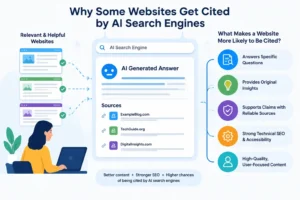
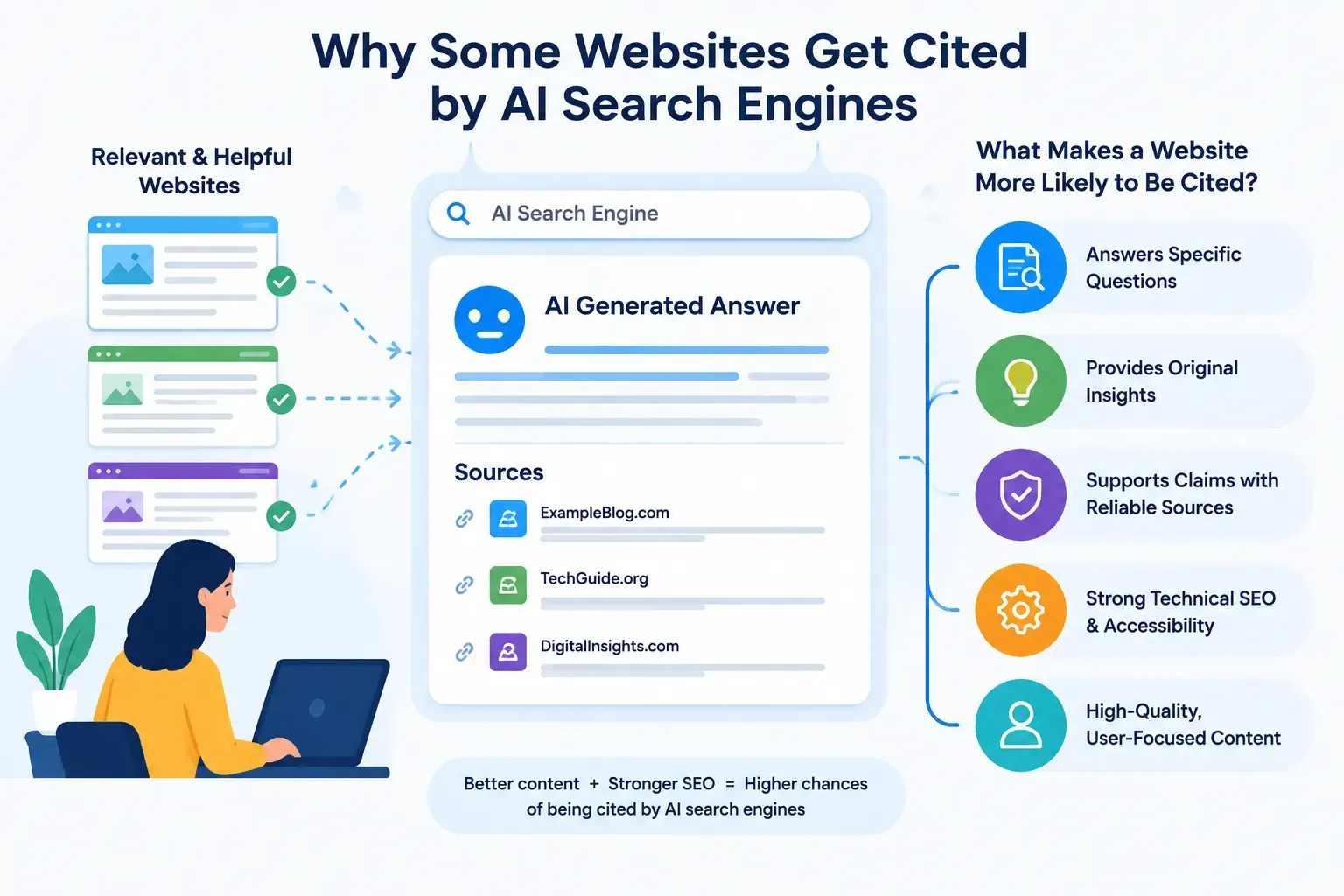
Many of the sites that have similar content as what is displayed in AI search results do not receive the same amount of visibility. There is a reason why this occurs. In addition to keywords and the length of articles, other factors are considered when determining the placement of a site within an AI search engine. AI search engines are attempting to find sites with useful, pertinent information that can aid users with answering their questions. Therefore, sites that produce unique perspectives, provide clear and easily understood explanations of complex concepts, and offer accurate and trustworthy information will be in a superior position to be discovered by AI search engines.
How Do AI Search Engines Choose Websites to Cite?
AI-based search engines gather relevant information from a number of different sources to provide answers to users’ queries. There may be times when an AI-based search engine links to another website with additional relevant data. The selection process for determining which sources will be used by an AI-based search engine is based on many variables such as the type of query submitted, the platform utilized, and the amount of content available at that moment.
A general article about digital marketing can cover topics such as local SEO but does not explain what happens when a business disappears from Google Maps. Therefore, a more specific, in-depth article that covers why a business is missing from Google Maps would be much more helpful for someone trying to find an answer to their question.
Google has announced that in order for pages to serve as supporting links for AI Overviews and AI Mode, the page must have been indexed by Google, and it must be able to show a preview (or snippet) in search results. Just because a page is indexed doesn’t mean it will be included.
Why Some Websites Get Cited More Often
The content of your article must directly address the main question asked by the user, without any extra introductory information. An example of how an article may provide an answer to a user who wants to know why his/her website traffic is increasing, but there are fewer inquiries, is to explain possible reasons for this difference in results (i.e. incorrect search intent alignment; low landing page performance; confusing placement of the call to action; or, insufficient conversion tracking).
The best way to help readers locate exactly what they need quickly is to begin with the most critical components of your article, answering them concisely and directly. Next, use practical examples to expand on each of these concise answers, providing additional detail. Finally, utilizing descriptive headings will enable your readers to easily scan and read through the entire article.
They Provide Original Information
There should be no need for readers to read the same thing twice. Thoughts that were first formed about a topic make the article unique to the reader.
Businesses can explain to people what they discovered during their campaigns; what steps were taken to resolve issues that arose; compare various methods of doing things as it relates to marketing; and/or share with them the lessons learned on other projects. For example, if a digital marketing company was able to demonstrate how they determined why there was a reduction in the number of leads generated through their website. In order to accomplish this, the company reviewed the visitors to their website, the number of forms completed online, and the number of telephone calls received.
Examples should be based on real experiences, not manufactured results. When writing content with more valuable information than what most writers provide, the reader will have greater faith in your writings, and will therefore be more inclined to reference your writings in their own research.
They Use Reliable Sources
Statements of significance must have support from appropriate evidence. Appropriate evidence includes official documents, government published works, original research studies, and recognized professional organizations, which can verify the truthfulness of a statement.
As well as separating factual information from subjective opinion, writers must explain why they believe a recommendation derived from testing with a limited number of participants (a small sample) is applicable to a specific situation, rather than being a universal solution. While using credible sources can help increase the writer’s credibility, the writer must realize that the use of credible sources does not guarantee that the AI will use them.
Does Technical SEO Matter for AI Search?
Yes. All of your useful content needs to be accessible to search engine robots. You need to make sure that the search engine robots can crawl the most important pages of your website. Additionally, you need to check that your robots.txt file is set up correctly to allow search engines to index your website. Finally, you must present all of your primary content in a format that can be read.
Clear page title, relevant internal linking, appropriate URL structure, mobile-friendliness, descriptive heading(s) are all factors that influence how easy it is to find your site online. When used properly, structured data enables search engine(s) to determine what type(s) of content you provide which can be indexed. However, Google does not require specialized artificial intelligence schema markup for inclusion in AI Overviews or AI Mode.
Can AI-Generated Content Get Cited?
Indeed, articles written by artificial intelligence may appear on a user’s search engine results page (SERP). However, the mere fact that an article was produced using artificial intelligence does not necessarily translate into value for the article.
When a website has several similar articles to those that other websites have written, and it does not include any substantive content in those articles, then there will be an issue. It is acceptable for articles to contain keywords that competitors use; however, they do not offer any valuable information.
How to Improve Your Chances of Getting AI Citations
To begin, determine precisely what questions the people in your target market are looking for answers to. You can utilize Google Search Console to learn the specific search phrases used by visitors to access your website and how effectively those web pages perform. Furthermore, feedback from customers can provide insight into other questions that were not addressed on your site.
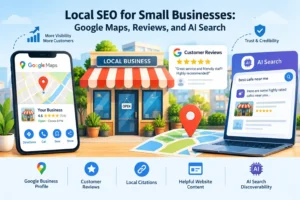
Produce material that relates to issues which are of concern to your audience. A sample of what could be included in a local SEO content cluster would be articles that address: optimizing your Google Business Profile; identifying and resolving problems with your local ranking; managing customer feedback through reviews; and developing location-specific landing pages. All of the articles in this cluster will address one specific issue each, and each will also link to further resources on that issue.
Improving the business’ visibility online can be achieved through focusing on relevant content, technical aspects of SEO, and an easy-to-understand digital marketing plan. Collaboration with a digital marketing firm such as Designyze will allow businesses to develop stronger content for their websites and create a more efficient search presence.Myth vs Reality: Artificial Intelligence Search Citations